ZHANGJIAJIE TOUR CLUB | Email: zjjclub@hotmail.com | Tel: 0086-744-8868856 | 繁體中文

Summer Palace
2013-03-13 15:37:08 Source: Comments:0 Hits:
2. Longevity Hill Area
The Longevity Hall is definitely the most magnificent area in the Summer Palace. Area where stand most of the buildings tracing back from the Qing Dynasty, its architecture is a curiosity for it follows an east-west symmetry where many buildings and gardens are to appreciate:
The Longevity Hill

Originally called the Wengshan Hill, the marvelous Longevity Hill was renamed by Emperor Qianlong in 1752, during the Qing Dynasty (1644-1911), at the time he ordered the construction of the garden. Of a 60 meters high (196.9 feet), the Hill is surrounded by many houses and buildings where relaxing among a gorgeous natural beauty.
At the foot of the front Hill, stands an ancient-style archway making the main entrance for climbing the hill. On the way up to the top, visitors may see the major buildings neatly ordered along a north-south ascending axis:
- The Gate of Dispelling Clouds (Paiyunmen)
- The Second Palace Gate (Ergongmen)
- The Hall of Dispelling Clouds (Paiyundian)
- The Hall of Moral Glory (Dehuidian)
- The Tower of Buddhist Incense (Foxiangge)
- The Hall of the Sea of Wisdom: on top of the hill
Mainly concentrated on the front hill, buildings are also present in the back such as the noteworthy miniature Potala Palace building in Tibetan lamasery style.
The Baoyun Pavilion
Located at the west of the Tower of Buddhist Incense (Foxiangge) on Longevity Hill, stands the Baoyun Pavilion (Baoyunge). Made of bronze, the building is often referred to as the "Golden Pavilion", one of China's three best preserved bronze buildings still existing today in the country. The architecture of the Baoyun Pavilion is something to pay attention to as it is a double-eaved roof of a 7.55 meters high imposing itself near to the Longevity Hill. Every single part of the pavilion is a curiosity for it is delicately carved and ornate with bright colors, bright marble in Buddhist style, pillars, tiles and bells.
During the reign of Emperor Qianlong (1736-1795), Lamas coming from Tibet stopped in the Summer Palace and this exact pavilion to pray for the Imperial family on the 1st and 15th day of each lunar month, especially during the Qing Dynasty (1644-1912). Buddha figures used to be hung on the brackets during ceremonies. In order to pay tribute to the people who casted the pavilion, their names have been engraved on the inner wall (Hanzhong, Yangguozhu, Gaoyonggu and Zhangcheng). Great method tracing back from China oldest ancient times, the casting savoir faire is one of the most precious building methods consisting in casting every single component separately. Surviving many fires, wars and calamities, the Baoyun Pavilion is a jewel around which a mystery developed after the thefts of 10 bronze windows weighing around 100 kilos each, unfound for around 70 years and suddenly reappearing, blackmailing the government to pay for money to see the windows again. Back to there original place after 90 years, the mystery over their original theft is still on today.
The Long Corridor/Gallery
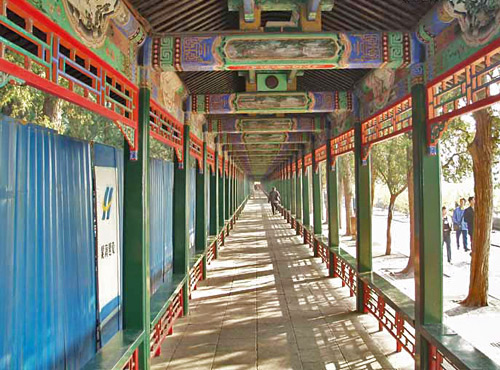
The Long Corridor is a 728 meters long (796.2 yards) gallery linking the Longevity Hill to the Kunming Lake. Longest corridor gallery in China, the building was even ranked as the longest one in the whole world in 1990. Used as a perfect promenade along the lakes, the Long corridor is a unique art gallery, featuring more than 14,000 pictures of landscapes, flowers, birds, human figures and stories on its beams and ceilings. Real carrier of China's ancient history, the corridor is giving an additional touch to the place surrounded by an amazing natural scenery. Smart connecter and primary route for visiting the whole garden, the Long corridor is a must see building in the Summer Palace.
The Hall of Dispelling Clouds
The Hall of Dispelling Clouds (排云殿Pai Yun Dian) is one of the most typical buildings of the Summer Palace. Red columns, golden yellow tiles roof and white marble balusters adorned with bronze dragons, phoenixes and vessels. Inside the hall, a throne is to be seen surrounded by a screen, incense burners and some fans. Ancient and elegant, the screen is an enamelwork embedded in a red backing. Together with the adjoining wing halls, the Hall of Dispelling Clouds has 21 rooms all of which are connected by cloisters.
Although the treasures on display inside are fewer than those in the Hall of Benevolence and Longevity, some of them are more valuable. Indeed, the beautiful middle rosewood throne with a dragon-in-clouds design, gorgeous sculpture, and fluid lines, is regarded as an awe-inspiring work of art. Each sides of the throne is surrounded by articles shaped in the Chinese character "寿" (shou), meaning longevity.
To the south of the Hall of Dispelling Clouds, visitors can direct themselves to the Gate of Dispelling Clouds located in the middle of the Long Corridor, dividing the corridor from east to west. The usual bronze lions standing on each sides of the door are symbolizing protection, and 12 stone statues of the Chinese zodiac animals: rat, ox, tiger, rabbit, dragon, snake, horse, sheep, monkey, rooster, dog and pig, the Imperial devotion to the universal system and the Heaven.
The Tower of Buddhist Incense
Symbol of the Summer Palace, the Tower of Buddhist Incense (佛香阁Fo Xiang Ge) is an elaborate work of Chinese classical architecture. Located on a hill in the center of the Summer Palace with buildings distributed symmetrically around its base, the tower is of a 40 meters height (131 feet), three-storied with 8 facades and quadruple-layered eaves, the whole supported by 8 pillars of lignum vitae wood: one of the most complicated structure ever realized.
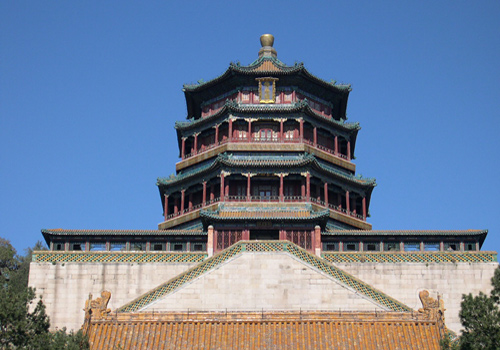
Noteworthy building in the vicinity of the Tower of Buddhist Incense is the Precious Cloud Pavilion (宝云阁Bao Yun Ge) located to the west of the tower. In order to enjoy a panoramic view of the area, travelers are invited to climb up to the tower.
As an Imperial worshipping tower, it enshrines a Buddha made in the Ming Dynasty (1368-1644) and called "the Buddha with One Thousand Hands and Eyes". Elegant and dignified, the statue is 5 meters high (16 feet) with 12 heads and 24 arms. Empress Dowager Cixi used to burn incense and pray in the tower on the 1st and 15th days of every lunar month.
The Hall of the Sea of Wisdom
The Hall of the Sea Wisdom (智慧海 Zhi Hui Hai) is the Summer Palace's building that symbolizes the mighty force and the infinite wisdom of Tathagada Buddha. Built on the pinnacle of the Longevity Hill, the Hall has been designed to stand at the upper end of an axis stretching from the Kunming Lake to the summit. When initially built during the reign of Emperor Qianlong (1711-1799), it was a 2-storied building entirely made of colored glaze bricks, without any timber beams: a realization known as the "No Beam Hall". Thanks to its timber-free frame, the hall survived the fire set by the Anglo-French allied force in 1860 although the holy statue of Amitayus Buddha, as well as 1008 smaller engraved Buddhas surrounding it, were destroyed.
Moreover, the Hall of the Sea of Wisdom is also where the worship of the Goddess of Mercy (Kuanyin) is occurring. Sitting straightly in the lotus throne with a jade pure bottle in one hand and willow leaves in the other, the statue is surrounded by other noteworthy relics such as the statues of Manjusri and Samantabhadra which are said to have been cast in the reign of the Emperor Qianlong. Visitors having some time visiting the hall will be impressed by the three characters written on the architraves of the hall for they form the Buddhist's chant: a real journey to spiritualism.
The Back Lake
Passing the Marble Boat toward the north and behind the Longevity Hill, the Kunming Lake is the part of the park narrowing significantly and forming the Back Lake (后湖Hou Hu). Covered with many structures and surrounded by water, the lake is a calm and cool place where taking some rest after the turmoil of Beijing city.
The Back Lake, called that way for it is secluded and quiet, wandering its way varying in width and rendering a great deal of fun and amusement. Little area representing the most famous areas of China, the Back Lake is a jewel of history. In the western section, peculiar huge rocks perched on the banks are a vivid representation of the marvelous scenery of the Three Gorges of the Yangtze River. The section in the middle of the lake is characterized by the Suzhou Market Street with shops lining on both banks, a unique scene of the Water Town south of the Yangtze River. This tranquil lake ends at the Garden of Harmonious Interests which serves as a grandiose epilogue.
The Suzhou Market Street
The Suzhou Market Street (Suzhou jie) is located behind the Longevity Hill, in the middle section of the Back Lake. The Market is a great interest, as the lake serves as the street with the stalls and shops on its banks. It has all the features of other market streets in Suzhou, a famous Water Town of China. The ancient-style street, about 300 meters long (328 yards), transports the tourist back to the mid-18th century of China.
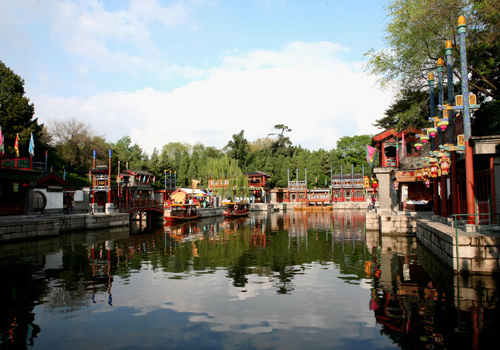
Originally built during the reign of Emperor Qianglong (1711-1799), the function of the market was to give to the Emperor and his Empress and concubines the experience of shopping in the Water Town. At that time, the eunuchs would act as clerks and shopkeepers, lending an air of realism to the experience. Over 60 old-styled stores, including restaurants, teahouses, pawn shops, banks, drugstores, clothing shops, dyers and publishing houses line the banks. The storekeepers, shop assistants, boaters and policemen on patrol are all dressed in traditional costumes of the Qing Dynasty (1644-1911).
The Garden of Harmonious Interests
Located beside the Kunming Lake, at the bottom eastern side of the Longevity Hill, the Garden of Harmonious Interests is of an exquisite design and distinctive layout a reason for its name as the "garden amongst the gardens of China". Indeed, its style is the most representative of the classical gardens of Southern China.
The idea of creating such a place came after Emperor Qianlong (1711-1799) conducted an inspection in South China in 1751. Coming back to Beijing, the Emperor developed a great affection for the Jichuang yuan Gardens in the city of Wuxi (Jiangsu Province). He then ordered that a similar garden be built in the Summer Palace, naming it the Huishan Garden, the precursor to the actual Garden of Harmonious Interests (1811). The garden was rebuilt in 1893 after some destruction.
Upon entering the Garden of Harmonious Interests, visitors are greeted by a magic panorama. Surrounded by slopes and with a lotus pond at its centre, the garden is comprised of 7 pavilions, 5 halls, numerous corridors and small bridges, all arranged with elegance. Noteworthy highlight to pay attention to is the reflection of all these typically Chinese sceneries into the pristine water of the pond. In ancient times, the pond was the fishing site of Empress Dowager Cixi. Funny history about the Empresse's taste for fishing as that every time Her Majesty went to fish, her eunuchs secretly dived into the water to hung live fish on her hook, in order to keep her in a relatively good spirit.
But what is exceptional about the Garden of Harmonious Interests is the 8 interests that can be enjoyed all around, developed as below:
- Interest of Seasons
- Interest of Pavilion
- Interest of Water
- Interest of Painting
- Interest of Bridge
- Interest of Corridor
- Interest of Calligraphy
- Interest of Imitation
Like many other natural sites, the beauty of the garden is changing along with seasons. Whether in summer, spring, autumn or winter time, the garden is still gorgeous for the pleasure of visitors worldwide. Water is maybe the element that is the most present in Chinese traditional gardens. The Garden of Harmonious interests is following the rule as many falls, and ponds give birth to winding streams where life is developing and wonderful sounds give a feeling of relaxation. Spanning the water with different styles, the bridges that can be admired in this part of the Summer Palace are parts of the historical and cultural relics tracing back from the ancient dynasties. The Xushi Path stele and stone inscription in the Moyun Room are also elements of interest for they ad to the park a painting dimension never seen anywhere else. Pavilions and corridors of different colors and architectural styles give to the scenery the typical Chinese sights that many of us are looking for when travelling to China.
Every single angle of the park is to discover. Harmonious and relaxing, the Garden of Harmonious interests is the perfect name for the most perfect garden China has ever been listing. A reason for understanding now why the Summer Palace has been listed to UNESCO!
Tags: Summer Palace
Previous: Beijing Badaling Great Wall
Next: Beijing National Stadium

Hot Tours
- Sunrise Highlight 4-Day Tour in Zhangjiajie
- The Popular 5 Days AVATAR Tour in Zhangjiajie
- 3 Days AVATAR Mountain&Baofeng Lake Tour
- 5-day happy tour in Zhangjiajie
- 7-Day Classic Rafting Tour in Zhangjiajie and Mengdong River
- 3-Day Economic Bicycle Tour in Zhangjiajie
- 4 Days Bicycle Tour in Zhangjiajie
- 5 Days Classic Culture Tour in Fenghuang and Zhangjiajie
- The Western Hunan Trip-Charming Culture Tour
- 5-day spring tour in Zhangjiajie
Why Choose Us?
-
We are experienced at helping guests build unique itineraries for the ideal Zhangjiajie experience. A Professional Team
 -
Our club promise the unbeatable value. No hidden costs. No Commission shopping.Unbeatable Value -
Our tour guides are the best. And when traveling with our club, we will always be available for you, 24 hrs a day.Remarkable Service -
We give assistance to buy or rent backpacking equipments for backpackers.Backpacking Equipments Service
[More Reasons]


 Skype: zjjclub
 Email: