ZHANGJIAJIE TOUR CLUB | Email: zjjclub@hotmail.com | Tel: 0086-744-8868856 | 繁體中文

Summer Palace
2013-03-13 15:37:08 Source: Comments:0 Hits:
Features of the Summer Palace
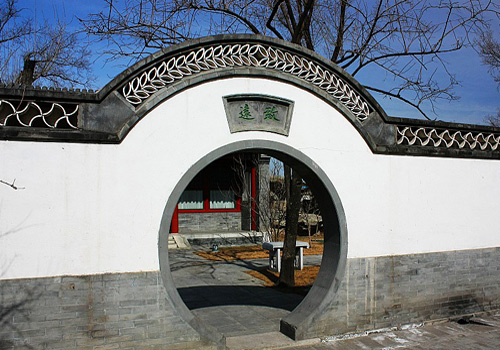
The Summer Palace is China's largest and most grandiose garden ever constructed. Covering an area of 2,9 km2, three quarters of which are covered of water, the palace is composed of over 3000 ancient structures including pavilions, towers, bridges and corridors. The Summer Palace is composed of 3 main areas:
- The Palace Area (for administration): is where ancient emperors used to take care of state affairs. There stands the Hall of Benevolence and Longevity (仁寿殿), where Empress Dowager Cixi held court behind a screen in most of the time of her late years.
- The Residence Area (for living): Jade Ripples Hall (玉澜堂), Hall of Joyful Longevity Hall (乐寿堂) and Yiyun Hall (宜芸馆)constitute the main bodies of this area where emperors and the royal family used to live during summer.
- The Tour Area (for relaxation): landscapes, buildings, flowers and plants appreciated by the royal family for its peaceful atmosphere.
All the Summer Palace spreads across the low hills and lakes among which the Longevity Hill (万寿山), and Kunming Lake (昆明湖) are the most important parts. Travelers visiting the site today have the opportunity to wander in the wonderful buildings and courtyards beside the lake and along the waterways. Arched bridges, promenades, decorated corridors and breezeways, an ever-changing scenery is waiting for visitors!
What to see in The Summer Palace today?
When visiting the Summer Palace, visitors should plan between one hour and a half to half a day for the site is really huge. Indeed, there are so many things to see in the palace that you will feel time spending quickly, realizing how life spent smoothly for emperors during their summer retreat. Involving plenty of walking, the Summer Palace is the place where experiencing different activities on top of little promenades.
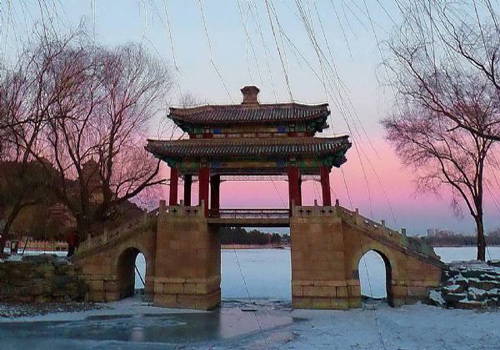
Riding a little boat for seeing the lake areas, watching a traditional Chinese dance performance at the Palace's Theatre or doing some shopping in the many traditional shops by the river…the Summer Palace is without any contests the lovelier scenic spot in Beijing city. Though not fully opened to the public, some interesting buildings can be visited flourishing with many ancient designs and decorations. Clearly, the park is divided into 4 several sections that are the Court Area, the Front-Hill Area, the Longevity Hill Area and the Kunming Lake Area. In the park, an integrated transport hub is at the disposal of visitors who may first stop at the Kunming Lake and Longevity Hill.
1. Court Area
The Court Area is located in the northeast of the park, spreading from the East Palace Gate to the northeast coast of Kunming Lake. It is remembered as the place where the famous (though terrific) Empress Dowager Cixi (ruling from 1861-1908) and Emperor Guangxu (1875-1908) used to reside, conducting state affairs though away from central Beijing and the Forbidden City. This area of the park is where seeing numbers of Halls and courtyards displaying the exact same architecture than other imperial places: a palace in the front and the garden behind it.
The East Palace Gate
Called "Dong Gong Men" (东宫门) in Chinese, the East Palace Gate is the major entrance to the Summer Palace with two side doors: the main door in the middle exclusively reserved to emperors, empresses and queen mothers and the side one for officials. The road leading to the entrance for emperors is chiseled with two relief dragons playing with a ball: a symbol of Chinese imperial dignity.
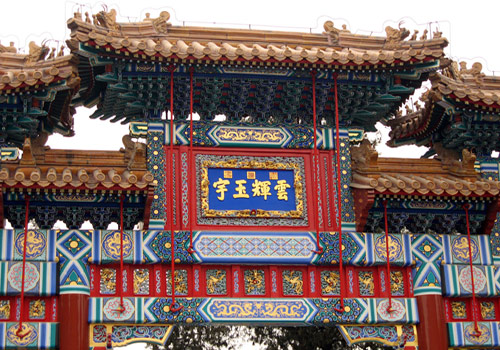
Upon entering the Gate, visitors will be impressed by the three big and vigorous characters meaning the Summer Palace in Chinese: 颐和园 (Yi He Yuan). It is said to be the handwriting of Emperor Guangxu who ruled the country from 1875 to 1908 under the supervision of Empress Dowager Cixi. The origin of these 3 characters is the center of a story passed for years from generation to generation. Indeed, during the restoration of the Summer Palace, craftsmen asked for Emperor Guangxu's own writing on the plaque to be disposed at the entrance of the Summer Palace. Pleased to accept their request, Emperor Guangxu wrote the three words of "颐和园". Angry at its nephew's calligraphy, Empress Dowager Cixi ordered to take off the characters, forcing then Guangxu to realize his bad writing and start to take lessons of calligraphy. After earnest efforts, the emperor finally succeeded in writing the characters in a proper way, using just one stroke. Satisfactory work, his writing is now to be admired at the East Palace Gate.
True or not, the characters at the entrance give to the Summer Palace a spiritual and forceful meaning showing the great sceneries and historical relics that are to be discovered in the park. By entering the East Palace Gate, visitors are walking into the state affairs and administrative area of emperors.
The Hall of Benevolence and Longevity
The Hall of Benevolence and Longevity (仁寿殿, Ren Shou Dian) is the first architectural complex to be seen by visitors when entering the site. Built in 1750 but burned down in 1860 by the Anglo-French forces, it was reconstructed in 1888 under the rule of Empress Dowager Cixi and Emperor Guangxu. This hall was originally called "Qinzheng Hall" to inspire rulers to manage state affairs diligently. However, during Emperor Guangxu's time (1875-1908), the hall's name was changed to the Hall of Benevolence and Longevity due to the famous Confucian saying: "The ruler who reigns benevolently will have a long life".
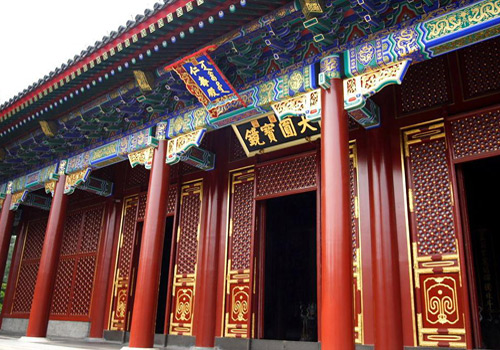
In front of the hall stand bronze phoenixes and dragons of a great beauty. In the courtyard, 4 unusual stones dark in color and with holes, represent the four seasons of the year such as in many other Imperial buildings where symbolism was used a lot to express Emperor's rule coming from the Heaven's decision. In the hall, several items can be admired such as a throne, a wall screen, some decorative fans made of peacock feather, incense burners, crane-shaped lights, etc… Exceptional among this list, the wall screen is a curiosity for it has 9 dragons and 226 times the Chinese character "Longevity" (寿), written in different styles. Located at the north of the Hall is the Well of Prolonging Life (延年井Yan Nian Jing) that is said to have saved Empress Dowager Cixi's life after she caught a sunstroke.
The Garden/Hall of Virtue and Harmony
The Garden of Virtue and Harmony (德和园 De He yuan) is where the Emperors and the Empress Dowager Cixi were used to be entertained. Performances of the Peking opera and many other theatrical shows were used to be held there for the pleasure and entertainment of the Imperial family. This garden consists of the Grand Theater Building, the Hall of Nurtured Joy, and the Dressing House.
The theatre building, 21 meters high (69 feet) and 17 meters wide (56 feet), consists of three stories stages with colorful and multiple eaves elegantly raised on every corners. From top to bottom, there are: The Fu Stage (Happiness Stage), The Lu Stage (Affluence Stage), and The Shou Stage (Longevity Stage).
Some inventive raise catwalks in the ceilings and a winch on the top of the floor are present, an ingenuous design that could create an impression of movement to the performers. Each stage was made of trapdoors. A well and pond is located beneath the Shou Stage (Longevity Stage) for it could suddenly come out creating a water scene as well as amplify a sound effect thanks to acoustic resonance. The lighting and sound systems heighten the whole effect.
Today, the garden is converted into an exhibition hall to display the daily utensils used by the Imperial family, including bronze wares, porcelains, jade articles and other precious objects.
The Hall of Joyful Longevity
This Hall was one of the first constructed under the reign of Emperor Qianlong (1711-1799) in order to make it a residence for his mother. Located at the northeast of the Summer Palace near to the Kunming Lake, the building unfortunately burnt down after the Anglo-French occupation in the 1860s, and was restored under Empress Dowager Cixi. The Empress took a real pleasure in spending her time in this Hall with her 48 attendants and a retinue of over a thousand people accompanying her inside the Summer Palace. Called Le Shou Tang (乐寿堂) in Chinese, the name has not been given without hazard as this is a tribute to the Analects of Confucius. Indeed, saying that "persons with wisdom are joyous, with benevolence longevous", the Emperor followed the rule looking for the longest reign on Earth for he was said to be the Son of the Heaven.
The Hall is where seeing a well-decorated throne, fans, copper incense burners, desk and rosewood inlaid shell carving glass screen. Porcelain tracing back from the Qing Dynasty (1644-1911) is also to be seen, a cultural relic that ranks as one of the most precious in China. On the ceiling of the Hall is a colorful pendant lamp that has been imported from Germany in 1903. At the east of the hall stands the inner chamber in and bedroom of Empress Cixi; at the west, the dressing room and at the behind it all the place where maid servants waited for order. When passing through the front gate, visitors will find themselves directing to the Kunming Lake, where boats were and still are docked. Finally, the Hall of Joyful Longevity is also composed of a small courtyard garden in which Emperors used to relax as well as impress visitors. Filled with flowers of any kinds representing peace, prosperity and having also the power to cure diseases, the garden was a great pride of the Court Area.
The Hall of Jade Ripples
The Hall of Jade Ripples, also called "Sanhe yuan" for it was a hint at the Jin Dynasty verse (265-316): "Jade spring with rippling water" is one of the most impressive place that had an important role in History. Built in 1726, under the reign of Emperor Qianlong (1711-1799), the building burnt down like many others during periods of evil, but was restored later on. Known as a place notable for its seclusion and harmonious arrangement, the Hall of Jade Ripples started to have another function after 1898, when The Hundred Days Reform led by Emperor Guangxu failed. Indeed, the reform aiming at reforming the outdated feudal system by creating a new edict had received a sharp disagreement from Empress Dowager Cixi that arrested Emperor Guangxu and placed him in the Hall of Jade Ripples, secluded from the outside world. Symbolic act of this disagreement was the separation of the two rocks located in front of the Hall that used to represent Cixi and Guangxu.
During his long life confinement, Guangxu used to live between his day room and his bedchamber. The chamber, located at the east of the Hall is a cozy one. Facing it, the day room is still today where seeing the Emperor's desk made of rosewood and decorated with exquisite carvings.
The Yiyun House/Hall
Last Empress of the Qing Dynasty (1644-1911), Empress Longyu, wife of Emperor Guangxu used to live in the Yiyuan Hall. Not beloved by her husband who preferred to spend more times with his concubines, the Empress passed her lonely days in that house located to the north of the Hall of Jade Ripples. Built during the reign of Emperor Qianlong and repaired in the reign of Emperor Guangxu, this literally "convenient to collect and read books" hall is embodying to perfection the elegance and knowledge of Empress Longyun.
Constructed in traditional Chinese "Siheyuan (四合院)" style, the Yiyun Hall is composed of 5 front rooms, 3 back rooms, 5 eastern affiliated rooms (Dao Cun Zhai) and 5 western affiliated rooms (Jin Xi Xuan), the affiliated being home to the Emperors' concubines in summer time. All the rooms are filled with splendid curiosities such as furnitures, precious stones and flower patterns cupboard.
Though located near to the lodging of Emperor Guangxu, the Yiyun Hall was not that accessible by the Emperor after the Reform Movement. Another confinement preventing him to enjoy his time seeing his different lovers.
Tags: Summer Palace
Previous: Beijing Badaling Great Wall
Next: Beijing National Stadium

Hot Tours
- Sunrise Highlight 4-Day Tour in Zhangjiajie
- The Popular 5 Days AVATAR Tour in Zhangjiajie
- 3 Days AVATAR Mountain&Baofeng Lake Tour
- 5-day happy tour in Zhangjiajie
- 7-Day Classic Rafting Tour in Zhangjiajie and Mengdong River
- 3-Day Economic Bicycle Tour in Zhangjiajie
- 4 Days Bicycle Tour in Zhangjiajie
- 5 Days Classic Culture Tour in Fenghuang and Zhangjiajie
- The Western Hunan Trip-Charming Culture Tour
- 5-day spring tour in Zhangjiajie
Why Choose Us?
-
We are experienced at helping guests build unique itineraries for the ideal Zhangjiajie experience. A Professional Team
 -
Our club promise the unbeatable value. No hidden costs. No Commission shopping.Unbeatable Value -
Our tour guides are the best. And when traveling with our club, we will always be available for you, 24 hrs a day.Remarkable Service -
We give assistance to buy or rent backpacking equipments for backpackers.Backpacking Equipments Service
[More Reasons]


 Skype: zjjclub
 Email: