Foreign visitors get a taste of local wedding customs in Zhangjiajie, Hunan province.
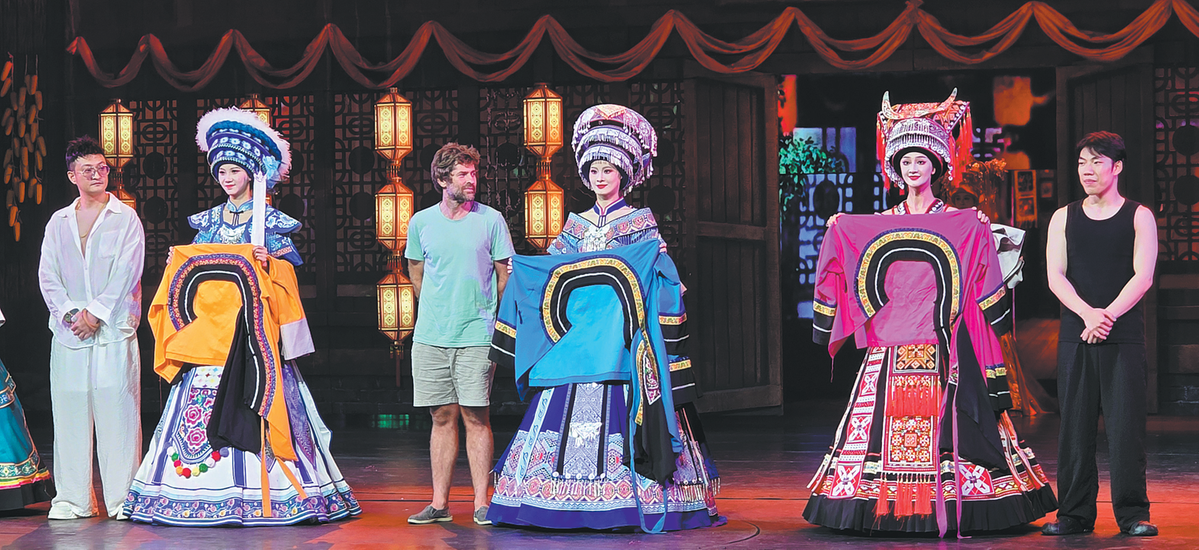
On a theater stage framed by the towering sandstone peaks of Wulingyuan Scenic Area in Zhangjiajie, Hunan province, Pablo, a Spanish tourist, donned traditional Tujia wedding attire, playing the role of bridegroom as hundreds of spectators cheered.
The mock ceremony at Charming Xiangxi Theater offered him an unforgettable introduction to local customs. For local business owners and operators, it represents something more strategic — a golden opportunity to attract tourist revenue after travelers descend from the world-famous Zhangjiajie peaks.
"We had never seen a performance like this," Pablo said afterwards. "I would like to learn more about traditional Chinese culture."
Across Zhangjiajie and neighboring historical towns in western Hunan, rising inbound arrivals are encouraging businesses to expand beyond scenic-area tickets into evening entertainment, accommodation, dining and cultural experiences.
Official data underscore the momentum. Zhangjiajie welcomed 860,700 inbound visits from 195 countries and regions in the first seven months, up by 19.01 percent year-on-year. Tourism foreign-exchange earnings increased 40.52 percent to $98.5 million.
The demographic profile of visitors is also undergoing a structural shift. European and US travelers accounted for nearly 35 percent of total inbound arrivals, with their numbers rising 211.36 percent year-on-year and helping diversify a market long dominated by travelers from South Korea.
This surge has been powered in large part by China's expanding visa-free policies. China has expanded unilateral visa-free access to citizens of 50 countries for stays of up to 30 days, while nationals of 57 countries are eligible for its visa-free transit policy, following the addition of Kyrgyzstan and Vietnam on Thursday.
Zhangjiajie Hehua International Airport is among the 65 designated ports for the transit policy. The airport operates 13 passenger routes to eight countries and regions, and long-haul travel Western visitors increasingly bundle the city into multi-stop itineraries across China.
For years, Zhangjiajie's international acclaim rested largely on its quartz-sandstone pillars, famously associated with the floating mountains in the blockbuster 2009 film Avatar. Today, regional stakeholders view these iconic vistas merely as the starting point of an extended consumer journey.
"The underlying business logic is to shift from one-off gate admissions to capturing spending across the entire travel chain as visitors extend their stays. Accommodation, dining, performances and immersive cultural experiences can all generate additional revenue," said Huang Yuanji, vice-president of Hunan University of Finance and Economics.
At Charming Xiangxi Theater, which showcases the heritage of the Tujia, Miao and other ethnic groups, the number of overseas visitors reached 116,000 from 188 countries and regions between January and July, up 43 percent year-on-year.
To bridge cultural divides, the theater provides subtitles in English and Korean, with Russian and Spanish in the works. Promotional materials have also been tailored. Traditional acrobatic acts, for example, are introduced using references to Chinese kung fu that foreign viewers intuitively grasp.
"Foreign visitors might not know what Xiangxi is, but they know Zhangjiajie's mountains and are interested in authentic traditions. Our job is to interpret local heritage in ways they understand," said Xu Shan, general manager of the theater.
A short distance away, Xiangxi Fu, a newly opened cultural tourism attraction in Wulingyuan, welcomes guests with traditional drum performances, ethnic folk songs and ceremonial welcome wine before ushering them into a courtyard complex dedicated to centuries of Tusi history.
The attraction says foreign visitors account for 30 to 40 percent of its tourists.
"Our goal is to transform static heritage exhibitions into participatory workshops and performances, giving visitors compelling reasons to linger in town after their mountain hikes," said Tang Linfang, the site's marketing director.
A different experiment is unfolding in downtown Zhangjiajie. On July 10, Dayong ancient town reopened after an extensive renovation led by Zhangjiajie mango cultural tourism, a joint venture involving local operators and leading broadcast media.
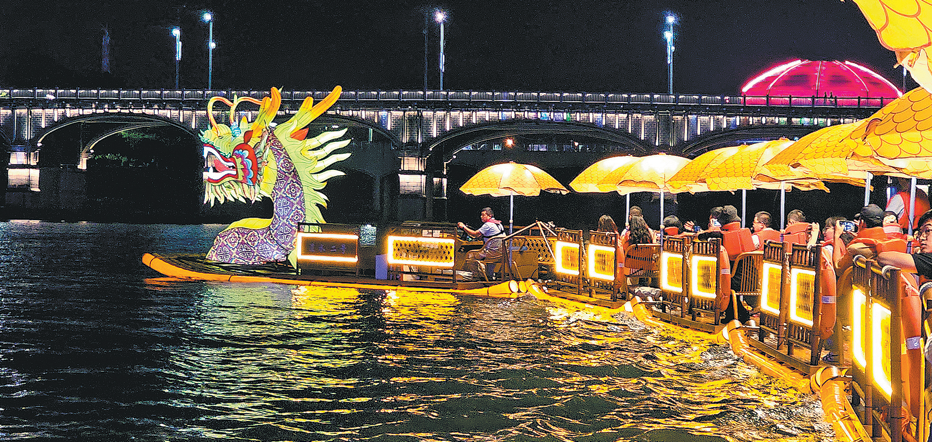
The riverside complex blends historical architectural style streets with television-themed shops, youth-oriented cultural merchandise, craft workshops, street performances and evening boat rides. Within its first month, it drew more than 1 million visits and generated more than 10 million yuan ($1.49 million) in business turnover.
"We want travelers who spend their daylight hours among the peaks to return downtown at night for an entirely different cultural texture," said Zhou Yang, general manager of the operating company, adding that roughly 80 percent of weekend visitors arrive after dusk.
This strategy to capture extended stays is rippling across neighboring destinations in the Xiangxi Tujia and Miao autonomous prefecture.
In the town of Furong, perched dramatically above a cascading waterfall, foreign tourists browse tea workshops, stroll through historical alleyways and stop to dine alongside locals who still live inside the centuries-old settlement.
The town received 6.53 million visits in 2025, including 338,000 from overseas, up 61 percent year-on-year, according to local official figures.
Zhong Fei, chairman of Hunan Huaxia Investment Group — which operates the destination through a JV with the local government — said international tourists accounted for roughly 40 percent of independent arrivals and about half of independent visitor spending.
Evening performances, guesthouses and hands-on workshops have helped extend average stays from half a day to one or two nights in the town, Zhong said.
Local restaurants have also adjusted. Local smoked pork appears on pizzas and in burgers, while coffee is sweetened with local ginger candy, offering foreign visitors familiar formats with local flavors.
"The visitors are not just coming for the scenery. They are interested in the culture and in seeing how local people live," Zhong said.
Crucially, the town has preserved its ancient social fabric, retaining native residents within the scenic core. The settlement hosts roughly 200 guesthouses and nearly 1,500 small nighttime enterprises, with locals making up 80 percent of the resort's workforce.
Further south, Fenghuang ancient town received 111,313 inbound tourist visits in the first half, up 5.12 percent year-on-year, while inbound tourism spending increased 15.18 percent to $44.3 million, said Xiang Yang, deputy head of the Fenghuang county government.
To connect these scattered gems, Hunan provincial authorities are accelerating development of the "Greater Zhangjiajie" international tourism zone, spanning 38 county-level areas across five cities and prefectures, including Zhangjiajie, Xiangxi and Huaihua.
The province has introduced eight inbound tourism routes and aims to attract 2 million inbound tourists annually by 2027, targeting $1.12 billion in inbound tourism spending.
Challenges persist. Huang said overseas travel agencies still tend to sell the mountain parks as standalone destinations, while fragmented administration, limited transport connections and uneven international services continued to restrict travel beyond Zhangjiajie's best-known attractions.
The provincial plan seeks to address those gaps by improving transport connections, developing cross-regional itineraries, upgrading multilingual services and encouraging tourism companies to work across administrative boundaries.
Huang emphasized that while eliminating low-cost package competition and administrative barriers takes time, the evolving mix of inbound visitors provides strong tailwinds for higher-value, tailor-made products.
The vibrant overseas reception across regional theaters, craft workshops and historic towns demonstrates that global travelers are eager to explore beyond the mountains.
"By improving regional connections and enabling travel agencies, hotels and cultural-tourism businesses to work together across the region, visitor flows can be converted into tangible and sustainable economic growth," Huang said.
He Chun in Changsha contributed to this story.