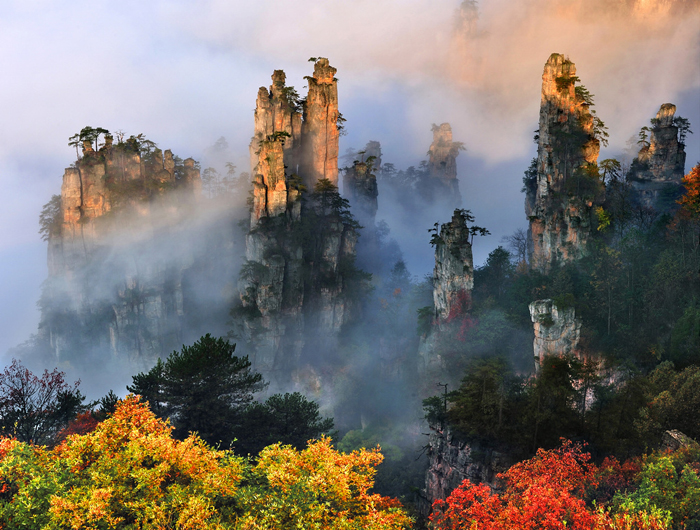
When visiting Zhangjiajie in 1986, the then lieutenant governor of Colorado State Nancy. E. Dick exclaimed that visitors to Zhangjiajie should pay five dollars for every breath. Indeed, Zhangjiajie boasts its peerlessly pure air in China. The forest park is a huge “natural oxygen bar”.
Lying in the humid Subtropical Monsoon Climate zone, Zhangjiajie has distinct four seasons with an annual average temperature of 16℃ and an annual average rainfall of 1400 mm. With the average annual sunshine 1440 hours and the rainfall 1400 mm, the hottest month in Zhangjiajie is in July with average temperature of about 27℃ and coldest month in January with average temperature of about 4.3℃..
Since the average altitude in Zhangjiajie is 183 meters and the altitude of the scenic spots area is about 1000 meters, the temperature during the day and night varies, reaching to 10℃.April and October are the best two months to go traveling in Zhangjiajie. At that time, you can enjoy the most beautiful natural sights of Zhangjiajie. In the winter time, Zhangjiajie takes on wonderful scenery after snowing and makes an appealing fairyland.
In spring when grass is lush and flowers blossoming and the streams as clear as crystal, you are recommended to go to Jinbian Stream, Shili hualang (ten-mile sightseeing corridor), Huanglong Cave, Baofeng Lake and Tianzi Mountain. You can definitely get the feeling that you’ve already entered a paradise on earth, a land of idyllic beauty, a different world.
When you come here in summer, Tianzi Mountain, Jinbian Stream, Baofeng Lake, Yuanjiajie and Mengdong River are good choices. You should be noted that it rains a lot in summer, especially in July. In one hour or two after the rain, visitors can get a fantastic feeling: as the mountains are surrounded by clouds and mist, it seems that you are walking in the fairyland.
In autumn, you can visit Tianzi Mountain, Yuanjiajie, Jinbian Stream andPhoenix Town (a very distinctive traditional town). The flowing clouds and mist form magnificent sceneries in Tiaizi Mountain after rain. Walking in Xihai stone forest would be a wonderful experience. What’s better, there are delicious fruits like Kiwi fruit and Chinese honey tangerine for you to taste.
Winter is not a popular season to go to Zhangjiajie, but you might get a different experience if you come in winter. When it snows, the snow-capped mountains seem more magnificent. Just make sure you wear clothes that are as thick as possible.
Zhangjiajie Climate Information
| Month |
Average High |
Average Low |
Average High |
Average Low |
Rain |
| (F) |
(F) |
(C) |
(C) |
(in) |
(mm) |
| Jan. |
44.2 |
34.7 |
6.8 |
1.5 |
2.57 |
65.4 |
| Feb. |
43.5 |
34.3 |
6.4 |
1.3 |
7.27 |
184.7 |
| Mar. |
58.8 |
46.8 |
14.9 |
8.2 |
3.17 |
80.5 |
| Apr. |
78.4 |
61.2 |
25.8 |
16.2 |
2.90 |
73.6 |
| May |
79.0 |
65.7 |
26.1 |
18.7 |
7.07 |
179.5 |
| June |
88.3 |
75.4 |
31.3 |
24.1 |
4.94 |
125.5 |
| July |
90.7 |
77.7 |
32.6 |
25.4 |
4.44 |
112.8 |
| Aug. |
85.8 |
74.8 |
29.9 |
23.8 |
6.95 |
176.5 |
| Sep. |
83.7 |
69.1 |
28.7 |
20.6 |
0.37 |
9.4 |
| Oct. |
71.4 |
56.7 |
21.9 |
13.7 |
3.10 |
78.8 |
| Nov. |
61.7 |
52.3 |
16.5 |
11.3 |
1.72 |
43.6 |
| Dec. |
49.5 |
39.4 |
9.7 |
4.1 |
0.44 |
11.3 |